
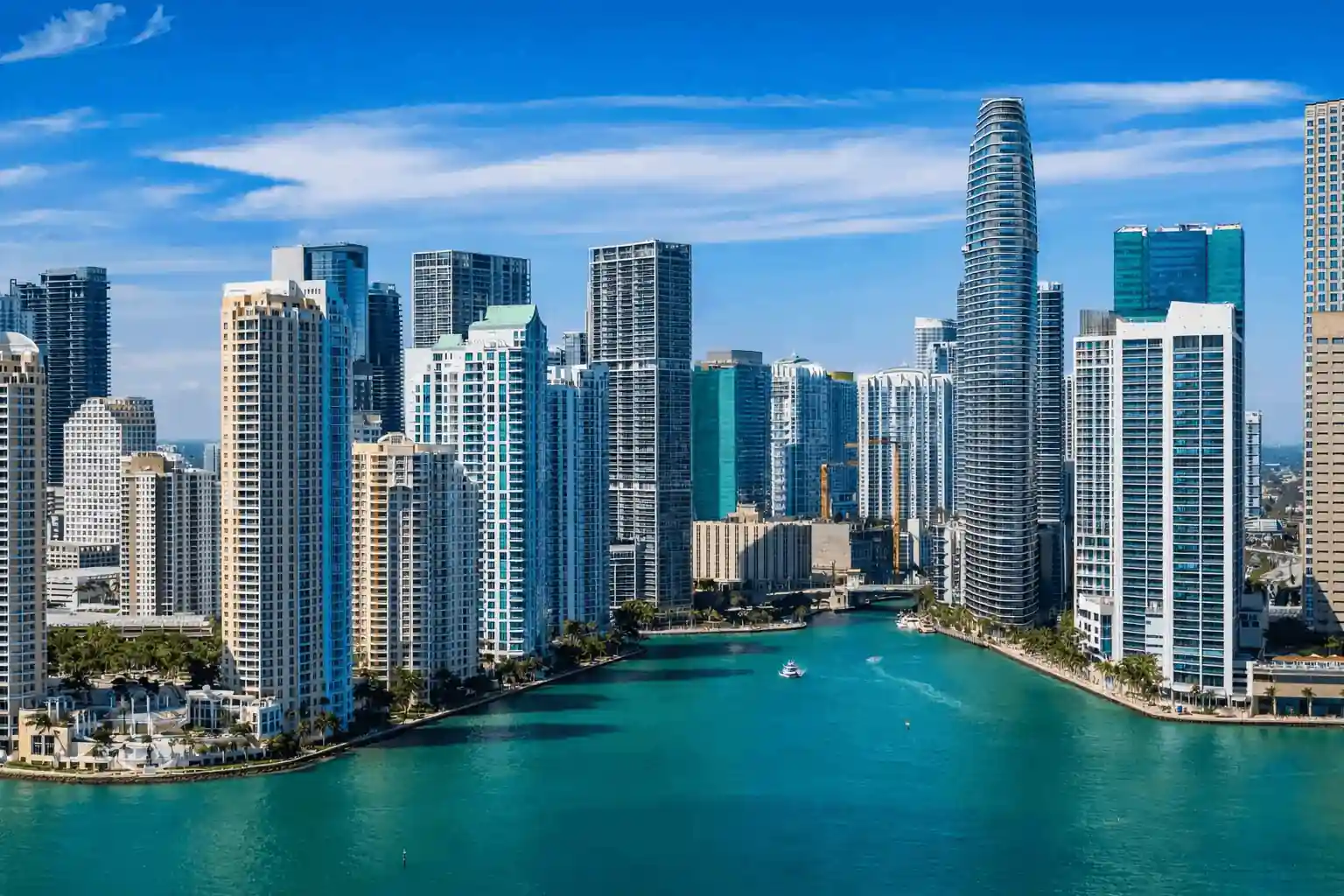
Brickell
Miami-Dade County
Brickell
Miami keeps its money in tall towers. They group around Biscayne Bay, and the street grid makes walking easy.
South Florida
Neighborhood Guides
Looking for a different town or district?
This search covers homes for sale in over 500 cities and neighborhoods.
Before you pick an area
Comparing South Florida areas
An area guide gives you the character of a place, but you buy one address at a time. Flood zones can shift between neighboring blocks. A condo and the house facing it are insured and taxed under different rules. And a commute that looks quick on the map at midday can be a very different trip at 8 a.m.
You can run these checks on any address in Miami-Dade, Broward or Palm Beach, even in an area we haven't written a guide for. With every check comes the public office whose records answer it, so you can see the answer firsthand before an offer goes in.
Due diligence
Six things to verify on any home
Flood zone and elevation
Every parcel has a flood zone on FEMA's maps. Zones starting with A or V are Special Flood Hazard Areas, and if your mortgage comes from a federally regulated lender, you'll need flood insurance there for as long as the loan lasts. Zone X marks lower mapped risk, which is still some risk. Sellers of Florida homes must also disclose in writing, no later than contract signing, any flood damage they know of, any flood insurance claim they've filed and any federal flood aid they've received.
42 U.S.C. §4012a · F.S. §689.302
Insurance before price
Line up a homeowners insurance quote, plus a flood quote if the property calls for one, while the price is still open, not once it's agreed. Insurers put a lot of weight on how old the roof is and how the windows and doors are protected. Florida makes them offer discounts for wind-mitigation features you can document, so an inspection report covering those features can change what you pay.
F.S. §627.0629
Property taxes after you buy
What the seller pays in property tax tells you little about what you'll pay. A sale triggers a reassessment at just value as of the next January 1, and your tax rate comes from the city, the county and whatever special district covers the address. Making it your permanent residence? Apply to the county property appraiser for the homestead exemption by March 1. Once it's granted, yearly increases in assessed value are capped at 3% or the change in inflation, whichever is lower.
F.S. §§193.155, 196.011, 689.261
Condo, townhouse or house
A condo purchase makes you part of an association, with its budget and its rules. If the building has three or more habitable stories, it must complete a milestone structural inspection no later than December 31 of the year it reaches 30, or by 25 if the local building official requires that for buildings near salt water. It also needs a fresh structural integrity reserve study every 10 years. Ask for both, plus the leasing rules, and read them before the view does your deciding.
F.S. §553.899 · §718.112(2)(g)
The commute at your hours
Time the commute on a weekday, leaving at the hour you actually would, then again in the evening. Count the bridges and causeways along the way: on a barrier island, those crossings decide how long every trip to the mainland takes.
What's planned for the block
What the next owner sees from the windows and hears at night is often decided in public records: the city's planning and zoning files for the streets nearby. Search them for towers already approved, rezoning applications, a new station or a road widening.
Three kinds of places
Coast, downtown or inland: what's different
Most South Florida addresses fit one of three settings. The type of home, what it costs and what you need to verify differ in each.
Coast and barrier islands
- The housing
- Expect condo towers facing the ocean, older low-rise buildings, and homes set on bayfront or canalfront lots.
- What drives the cost
- Expect to pay for wind coverage and, in high-risk zones, flood coverage too; condo associations budget for seawalls, roofs and concrete work.
- Verify before an offer
- Ask for the elevation certificate and look up the zone; read the building's milestone inspection and reserve study; time the causeway crossing at rush hour.
City centers and high-rises
- The housing
- Mostly amenity-rich towers, with lofts and townhouses at the fringes. Offices, transit and restaurants are close by.
- What drives the cost
- The association fee carries the building's staff and amenities, its insurance and its reserves. Parking can be a separate purchase or lease.
- Verify before an offer
- Read the leasing rules for the minimum rental term, ask whether a special assessment is approved or on the table, and confirm what the fee covers.
Inland neighborhoods
- The housing
- Townhouses, single-family homes with bigger lots, and newer planned communities.
- What drives the cost
- Roof age and construction for insurance, HOA dues, and in some newer communities a community development district (CDD) assessment on top of county taxes.
- Verify before an offer
- What the HOA and CDD charge, permits and age of the roof, and travel time at the hours you'd be on the road.
Treat all of this as a pattern, not a rule. Some coastal streets are in zone X and some inland canal lots are in zone AE, so only the address tells you.
Using this page
From guides to a shortlist
Don't stop at one guide
In every guide: where the area is, what kind of housing it has, the ways to get around and what's close by. Put two or three next to each other and you'll learn more than from a close read of a single one.
Browse homes for sale
The guide describes the area; for counts, the Homes for sale button opens its live search, showing prices, sizes and days on market as they stand right now.
Compare two areas directly
Compare Areas shows two places side by side, measured the same way, so you can weigh the trade-off on a single screen.
Verify an address in the public record
The flood zone, assessed values and permits for any home are on the public record, along with the building's filings when it's a condo. Once one catches your eye, pull them up, and use the checks above to know what matters.
Visit twice
Once on a weekday at rush hour and once on a weekend evening. Walk the street, drive the route, and stand where the noise would be.
Questions
Common questions about the area guides
Why don't I see a guide for my city or neighborhood?
The guides are a selection, not the edge of the map. The home search covers more than 500 cities and neighborhoods across South Florida, and every check on this page applies to any of them. You can also ask about a place directly.
Do the guides tell me which area suits me?
No. A guide describes the place, its housing, distances, parks and transit, and the decision stays yours. To get started, take the Neighborhood Quiz: it builds a shortlist from what matters to you.
Where do a guide's market numbers come from?
Each time you open a guide, the numbers are recalculated from current listings within that area's boundary. They reflect homes still on the market rather than sales that have closed. To judge a particular home, look at what sold nearby recently; that tells you more than an area median.
How can I find out which flood zone an address is in?
Look up any address on FEMA's Flood Map Service Center to see its official zone. The zone doesn't tell you the building's own elevation; for that you need an elevation certificate, completed by a licensed professional. Ask the seller if the home has one.
Is every home in an area taxed the same?
No. Your bill depends on two things: the rate, set by the city, the county and any special district such as a CDD, and the taxable value, which comes from the home's own assessment and exemptions. On the same street, two similar houses can have very different bills if one has been under a homestead cap for years.
Keep going
Ways on from here
- Compare AreasLine up two places and compare them on the same measures.
- Neighborhood QuizAnswer seven questions about where you'd like to be and get three areas to compare.
- Property PassportPull up a property's public file to see its flood zone, assessed values and permit history.
- Florida Home InsuranceA premium estimate to have in hand before you settle on a price.
Sources
The original sources behind the rules cited here.
- FEMA Flood Map Service Center
- 42 U.S.C. §4012a — flood insurance requirement
- F.S. §689.302: seller flood disclosure
- F.S. §627.0629: wind-mitigation discounts
- F.S. §193.155: homestead assessments
- F.S. §196.011 — exemption filing
- F.S. §689.261 — property tax disclosure
- F.S. §553.899 — milestone inspections
- F.S. §718.112 — structural integrity reserve study
- F.S. §190.048: CDD disclosure